Module 15: Patient Communication and Cultural Diversity in Dermatology
Learning Outcomes
Section titled “Learning Outcomes”By the end of this module, students should be able to:
-
Demonstrate effective communication skills when delivering dermatological diagnoses, including chronic conditions.
-
Counsel patients on treatment adherence, managing expectations, and addressing psychological impacts of skin disease.
-
Provide culturally sensitive dermatological care, recognizing differences in presentation, diagnosis, and management across diverse skin types, with emphasis on Fitzpatrick skin types common in Malaysia and Asia.
-
Adapt patient education to respect cultural beliefs, stigmas, and health literacy levels.
-
Employ strategies to support patients psychologically affected by visible or chronic skin diseases.
1. Effective Communication in Dermatology
Section titled “1. Effective Communication in Dermatology”-
Delivering Diagnoses:
-
Use clear, non-technical language.
-
Break complex information into manageable parts.
-
Confirm patient understanding via teach-back methods.
-
Acknowledge emotional responses; provide empathy.
-
-
Counselling on Chronicity:
-
Explain the long-term nature of many skin diseases (e.g., eczema, psoriasis, acne).
-
Discuss flare triggers and the cyclic course.
-
Set realistic expectations about symptom control vs. cure.
-
-
Treatment Adherence:
-
Explain rationale for prescribed treatments and importance of consistency.
-
Discuss potential side effects and how to manage them.
-
Encourage involving family/support persons where appropriate.
-
-
Psychological Support:
-
Recognize emotional distress from visible skin conditions (anxiety, depression, social withdrawal).
-
Screen using simple tools or direct inquiry.
-
Provide reassurance and referral options (psychology, support groups).
-
Address stigma or cultural beliefs that may affect psychological well-being.
-
2. Cultural and Regional Diversity in Dermatology
Section titled “2. Cultural and Regional Diversity in Dermatology”-
Skin Type Diversity:
-
Overview of Fitzpatrick skin types I–VI.
-
Common skin disorders with unique presentations in darker skin tones (e.g., post-inflammatory hyperpigmentation, keloids).
-
Differences in erythema visibility and lesion appearance.
-
-
Regional Skin Conditions:
-
Conditions more prevalent in tropical climates (e.g., fungal infections, parasitic infestations).
-
Cultural practices influencing skin health (e.g., use of traditional medicines, cosmetics).
-
-
Culturally Sensitive Care:
-
Respect for cultural beliefs around skin conditions.
-
Awareness of potential taboos and myths impacting presentation and treatment acceptance.
-
Language considerations and use of interpreters if needed.
-
-
Visual Examples:
- Images illustrating dermatologic conditions across Fitzpatrick skin types common in Malaysia and Asia.
3. Common Dermatologic Conditions in Asian Skin (Fitzpatrick III–V)
Section titled “3. Common Dermatologic Conditions in Asian Skin (Fitzpatrick III–V)”These skin types are prevalent among Malaysians of Chinese, Indian, and Malay descent. Conditions often present differently due to higher melanin content and unique dermal responses.
Pigmentary Disorders
-
Melasma: Symmetrical hyperpigmentation on the cheeks and forehead, common in middle-aged women.
-
Freckles & Lentigines: Small brown spots due to sun exposure.
-
Nevus of Ota & Hori’s Nevus: Bluish or brownish macules on the face, often bilateral.
Post-Inflammatory Hyperpigmentation (PIH)
-
Occurs after acne, eczema, or trauma.
-
More persistent and darker in higher Fitzpatrick types.
Acne & Scarring
-
Common in adolescents and adults.
-
Scarring tends to be more pigmented and hypertrophic.
Keloids & Hypertrophic Scars
-
More frequent in darker skin types.
-
Raised, firm scars that extend beyond the original wound.
Atopic Dermatitis
- Presents with lichenification and pigmentation changes.
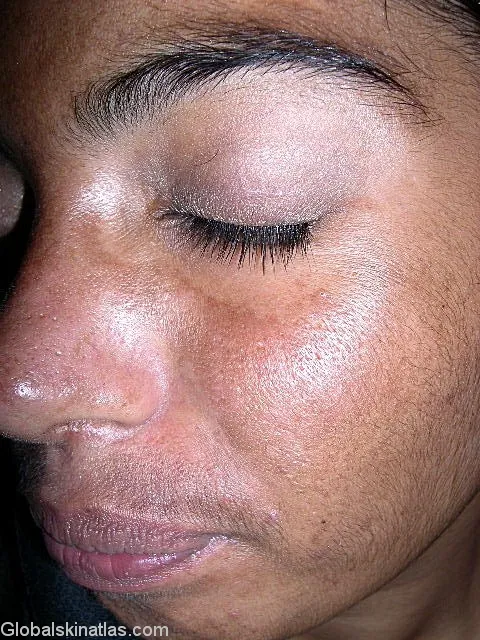
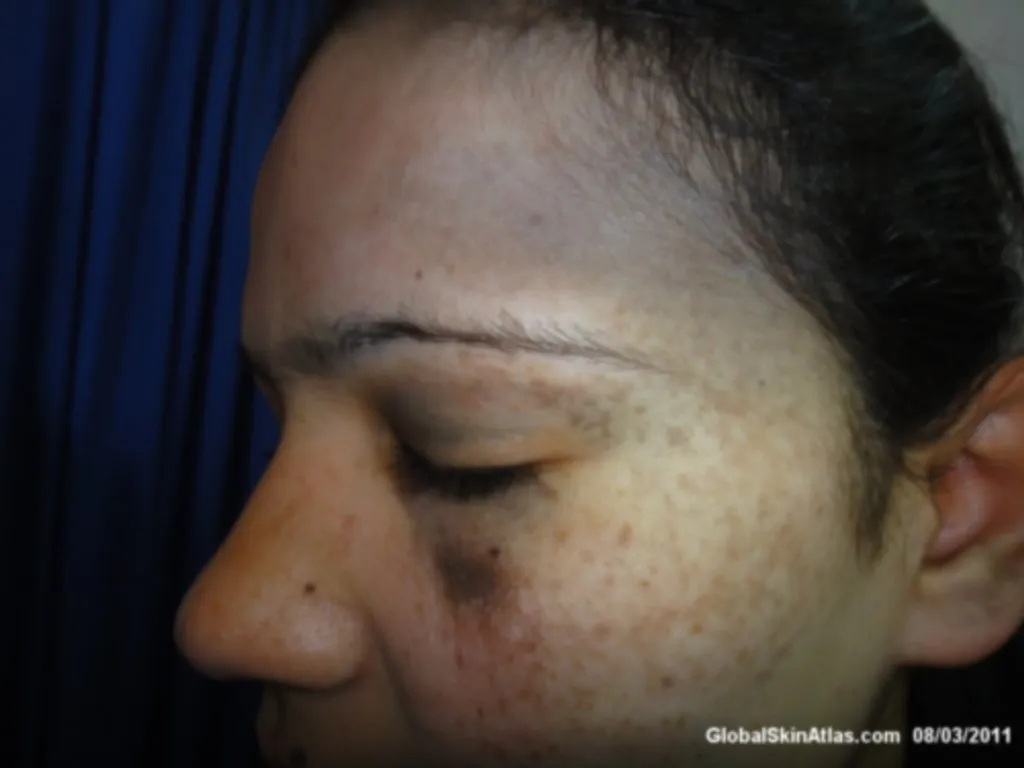
Fig. 15.1: Skin pigmentation — (1) Melasma, (2) Nevus of Ota & Nevus spilus
Image sourced from GlobalSkin Atlas.
Further reading: Asian Dermatologic Patient – Springer Journal and Asian Skin: A Reference Colour Atlas of Dermatology
4. Fitzpatrick Skin Type Classification
Section titled “4. Fitzpatrick Skin Type Classification”The Fitzpatrick classification is widely used in dermatology to assess skin response to ultraviolet (UV) radiation and guide treatment decisions.
Table 15.1: Fitzpatrick Skin Type Classification
| Type | Skin Tone | Sun Reaction | Common Ethnicities |
|---|---|---|---|
| I | Very fair, pale white | Always burns, never tans | Northern Europeans |
| II | Fair, white | Usually burns, tans minimally | Central Europeans |
| III | Medium, beige | Sometimes mild burn, tans uniformly | Southern Europeans, Malays |
| IV | Olive, light brown | Rarely burns, tans easily | Asians, Malays, Indians |
| V | Brown, dark brown | Very rarely burns, tans very easily | South Asians, Malays, Africans |
| VI | Deeply pigmented dark brown to black | Never burns, deeply pigmented | Africans, Afro-Caribbeans |
Table 15.2: Key Uses of the Fitzpatrick Skin Type Classification in Dermatology
| Application | Clinical Implications |
|---|---|
| Laser and light therapy planning | Types IV–VI absorb more laser energy; adjust wavelengths and energy settings; use long-pulsed or fractional lasers; avoid aggressive treatments to prevent burns or pigmentation changes |
| Risk assessment for sun damage and skin cancer | Lighter types (I–III) are more prone to UV-induced damage; recommend high-SPF sunscreens, protective clothing; schedule regular skin checks; educate on early signs of skin cancer |
| Predicting post-inflammatory hyperpigmentation | Darker types (IV–VI) more susceptible to PIH; minimize invasive or irritating treatments; use gentle topicals and strict sun protection; consider pre-treatment with skin lighteners before procedures |
| Choosing appropriate skincare and cosmetic treatments | Sensitivity and pigmentation response vary; select non-comedogenic, fragrance-free, gentle formulations; avoid harsh exfoliants or strong acids in darker skin; customize peels, microneedling, and laser facials accordingly |
Multiple Choice Questions
Section titled “Multiple Choice Questions”Tap an answer to check yourself — the correct option and an explanation appear once you choose.
Q1 What is the best approach when delivering a chronic dermatological diagnosis to a patient?
Effective communication requires clear non-technical language, confirming understanding via teach-back, and acknowledging emotional responses. Simply stating a diagnosis or handing out a leaflet fails to address the patient's emotional needs and risks poor comprehension.
Q2 Which Fitzpatrick skin type is most common in the Malaysian population?
Malaysians of Malay, Chinese, and Indian descent predominantly fall within Fitzpatrick types III–IV (medium beige to olive/light brown), reflecting the moderate-to-high melanin content characteristic of Southeast Asian populations.
Q3 In patients with darker skin types, what dermatological feature may be less visible or present differently?
Erythema (skin redness) is produced by dilated superficial vessels, which is visually masked by higher melanin content in darker skin types. Clinicians must rely on other cues — warmth, texture change, and patient-reported symptoms — when erythema is not apparent.
Q4 Which of the following is a culturally sensitive approach when discussing treatment with patients?
Culturally sensitive care includes respecting the role of family in decision-making where culturally appropriate, using interpreters when needed, and addressing beliefs or taboos that may affect treatment acceptance. Overriding patient concerns undermines shared decision-making and adherence.
Q5 What is an important feature of counselling for treatment adherence in chronic skin diseases?
For chronic conditions such as eczema, psoriasis, and acne, adherence depends on patients understanding the rationale for consistent treatment and the value of follow-up. Setting realistic expectations (symptom control, not necessarily cure) and openly discussing side effects improves long-term engagement.
Short Answer Questions
Section titled “Short Answer Questions”SAQ 1: Communication Principles
Section titled “SAQ 1: Communication Principles”SAQ
List four key communication principles when delivering a chronic dermatology diagnosis.
Reveal model answer
-
Use clear, non-technical language — avoid jargon; explain the condition in terms the patient can understand.
-
Break information into manageable parts — deliver key facts in stages; do not overwhelm the patient with everything at once.
-
Confirm understanding via teach-back — ask the patient to repeat back what they have understood to identify gaps.
-
Acknowledge emotional responses and provide empathy — recognise that a chronic diagnosis may cause anxiety, low self-esteem, or social withdrawal, and respond with reassurance and referral options where appropriate.
SAQ 2: Psychosocial Impact of Skin Disease
Section titled “SAQ 2: Psychosocial Impact of Skin Disease”SAQ
Describe three psychosocial issues patients with visible skin diseases might face.
Reveal model answer
-
Anxiety and emotional distress — visible skin lesions or disfigurement can provoke ongoing worry about appearance and social perception.
-
Depression and low self-esteem — chronic or stigmatised conditions (e.g., psoriasis, vitiligo, acne) are associated with reduced self-confidence and social withdrawal.
-
Stigma from cultural beliefs or myths — some skin conditions carry cultural taboos or misconceptions (e.g., perceived as contagious or a sign of poor hygiene), compounding the patient’s psychological burden and reducing willingness to seek care.
SAQ 3: Fitzpatrick Skin Types and Clinical Presentation
Section titled “SAQ 3: Fitzpatrick Skin Types and Clinical Presentation”SAQ
Explain how Fitzpatrick skin types influence the clinical presentation of skin lesions.
Reveal model answer
-
Erythema visibility — erythema is less visible in darker skin types (IV–VI) due to higher melanin masking underlying vasodilation; clinicians must look for warmth, texture change, and patient-reported symptoms.
-
Post-inflammatory hyperpigmentation (PIH) — darker types are more susceptible to PIH after inflammation, trauma, or procedures; the pigmentation is more persistent and darker.
-
Keloids and hypertrophic scars — more frequent in darker skin types; scars tend to be raised, firm, and extend beyond the original wound margin.
-
Acne scarring — scarring in higher Fitzpatrick types tends to be more pigmented and hypertrophic compared to lighter skin types.
SAQ 4: Culturally Sensitive Adherence Strategies
Section titled “SAQ 4: Culturally Sensitive Adherence Strategies”SAQ
Outline culturally sensitive strategies a clinician can use to improve treatment adherence.
Reveal model answer
-
Respect cultural beliefs and address myths — acknowledge and explore beliefs or taboos around the condition or prescribed treatments (e.g., concerns about topical steroids) before providing education.
-
Use interpreters and plain language — where language barriers exist, involve trained interpreters; use simple analogies relevant to the patient’s cultural context.
-
Involve family members where appropriate — in cultures where family plays a central role in health decisions, engaging a trusted family member can reinforce adherence.
-
Adopt a shared decision-making approach — invite patient participation in the management plan; avoid overriding concerns, as this reduces trust and long-term compliance.
OSCE Stations
Section titled “OSCE Stations”OSCE 1: Delivering a Diagnosis of Psoriasis
Section titled “OSCE 1: Delivering a Diagnosis of Psoriasis”Scenario: A 30-year-old patient has just been diagnosed with chronic plaque psoriasis. Task: Explain the diagnosis in clear, comforting terms; discuss the chronic course and management goals; and address patient concerns.
Self-assess against checklist
Tick each point you covered, then check your score.
- Uses non-technical language to explain what psoriasis is.
- Validates patient emotions and acknowledges the impact of a chronic diagnosis.
- Explains the long-term and cyclic nature of psoriasis, including flare triggers.
- Sets realistic expectations — symptom control rather than cure.
- Explains the importance of treatment adherence and consistency.
- Checks patient understanding using a teach-back approach.
- Discusses potential psychosocial impact (low self-esteem, social withdrawal, anxiety).
- Offers referral options such as psychology or support groups if distress is significant.
- Invites and responds to patient questions in an empathetic manner.
OSCE 2: Counselling a Patient with Post-Inflammatory Hyperpigmentation on Darker Skin
Section titled “OSCE 2: Counselling a Patient with Post-Inflammatory Hyperpigmentation on Darker Skin”Scenario: A 22-year-old Malaysian woman with a darker skin type (Fitzpatrick IV) presents with hyperpigmented patches following acne. Task: Explain the cause of hyperpigmentation, outline management and prevention, and discuss cultural considerations and realistic expectations.
Self-assess against checklist
Tick each point you covered, then check your score.
- Explains that post-inflammatory hyperpigmentation (PIH) occurs after skin inflammation, such as acne, and is more persistent in darker skin types.
- Addresses skin-type-specific concerns — higher Fitzpatrick types are more susceptible to PIH.
- Advises on strict sun protection (sunscreen, protective clothing) to prevent worsening pigmentation.
- Discusses avoidance of harsh exfoliants or irritants that could worsen PIH.
- Provides realistic expectations about treatment timeline — pigmentation may take months to fade.
- Acknowledges any cultural beliefs or concerns about skin appearance that may affect adherence.
- Encourages questions and responds empathetically throughout the consultation.
OSCE 3: Addressing Treatment Adherence in a Multicultural Setting
Section titled “OSCE 3: Addressing Treatment Adherence in a Multicultural Setting”Scenario: A middle-aged patient from a different cultural background is hesitant about using prescribed topical steroids. Task: Explore patient beliefs and concerns, provide culturally appropriate education on benefits and risks, and develop a shared plan to improve adherence.
Self-assess against checklist
Tick each point you covered, then check your score.
- Demonstrates active listening — allows the patient to express concerns fully without interruption.
- Shows respect for cultural beliefs and avoids dismissing the patient’s hesitancy.
- Explores specific concerns (e.g., fear of side effects, traditional medicine preferences, cultural taboos).
- Educates using culturally relevant analogies or plain-language explanations of benefits and risks.
- Acknowledges the patient’s autonomy and validates the right to ask questions.
- Invites patient participation in decision-making — offers a shared management plan.
- Confirms patient understanding using teach-back and addresses remaining doubts before closing the consultation.