Module 3: Acne and Rosacea
Learning Outcomes
Section titled “Learning Outcomes”-
Describe the pathophysiology and aetiological factors of acne vulgaris and rosacea, including hormonal influences, microbial involvement (e.g., Cutibacterium acnes), and inflammatory pathways.
-
Differentiate the clinical subtypes and severity grading of acne and rosacea, and correlate these with appropriate diagnostic criteria and patient history.
-
Formulate evidence-based management plans for acne and rosacea, incorporating pharmacological (topical and systemic), non-pharmacological, and lifestyle interventions, while considering patient-specific factors such as age, comorbidities, and psychosocial impact.
1. Pathophysiology and Clinical Presentation
Section titled “1. Pathophysiology and Clinical Presentation”Acne Vulgaris
Section titled “Acne Vulgaris”-
Understand the four pathogenic factors:
-
Sebum overproduction (androgen-driven).
-
Follicular hyperkeratinization leading to comedone formation.
-
Cutibacterium acnes proliferation in the pilosebaceous unit.
-
Inflammatory response involving cytokines and neutrophils.
-
-
Differentiate lesion types:
-
Non-inflammatory: open (blackheads) and closed (whiteheads) comedones.
-
Inflammatory: papules, pustules, nodules, cysts.
-
-
Recognize distribution patterns:
- Face (T-zone), chest, upper back, shoulders.
-
Classify severity:
-
Mild: comedonal.
-
Moderate: papulopustular.
-
Severe: nodulocystic or conglobata.
-
Table 3.1: Types of Lesions
| Lesion Type | Description |
|---|---|
| Superficial lesions | Open and closed comedones (blackheads and whiteheads) — comedones |
| Papules (small, tender red bumps) | |
| Pustules (white or yellow “squeezable” spots) | |
| Deeper lesions | Nodules (large painful red lumps) |
| Pseudocysts (cyst-like fluctuant swellings) | |
| Secondary lesions | Excoriations (picked or scratched spots) |
| Erythematous macules (red marks from recently healed spots, best seen in fair skin) | |
| Pigmented macules (dark marks from old spots, mostly affecting those with dark skin) | |
| Scars of various types — scars |
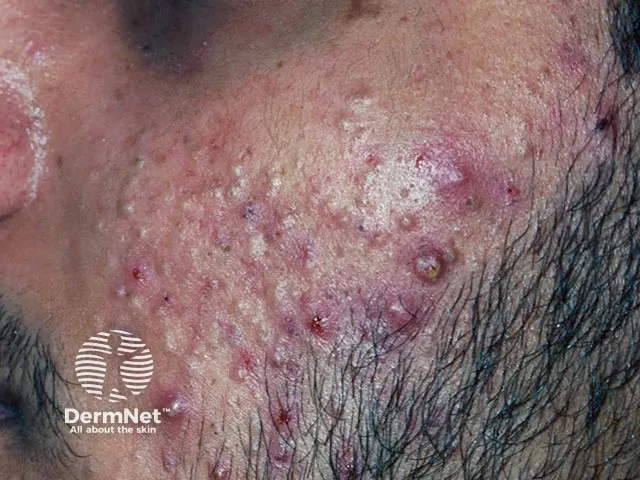
Fig. 3.1: Acne — comedones, papules, and pustules
Image sourced from DermNet.
Rosacea
Section titled “Rosacea”-
Identify key features:
- Persistent centrofacial erythema, telangiectasia, papules/pustules.
-
Understand subtypes:
-
Erythematotelangiectatic: flushing, visible vessels.
-
Papulopustular: acne-like lesions without comedones.
-
Phymatous: thickened skin, rhinophyma.
-
Ocular: blepharitis, conjunctivitis, dry eyes.
-
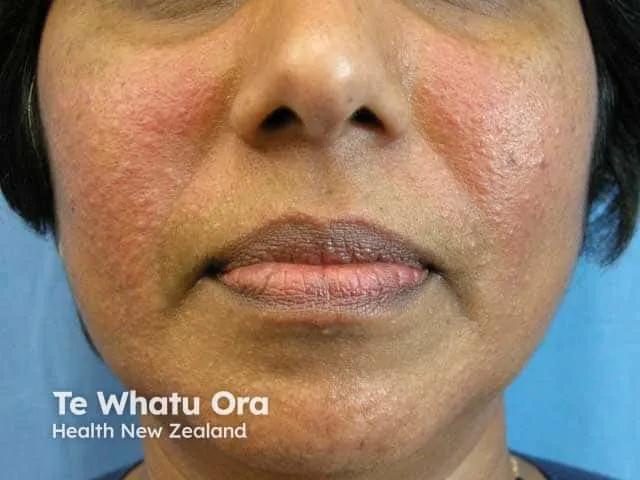
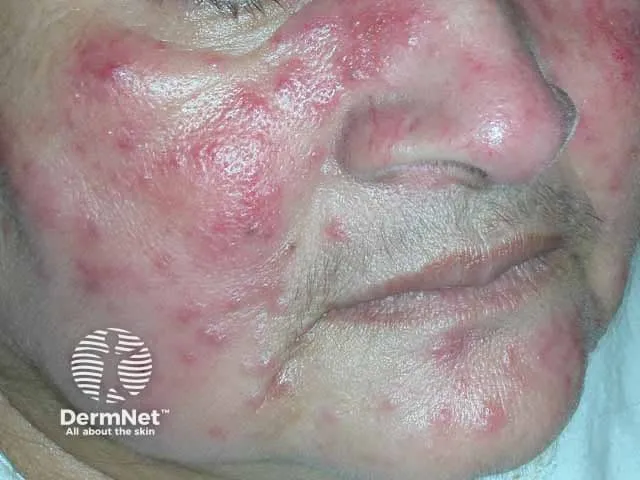
Fig. 3.2: Rosacea of the cheeks
- Papular rosacea of the cheeks
- Papulopustular rosacea of the cheeks
Image sourced from DermNet.
-
Recognize triggers:
- Heat, alcohol, spicy food, UV exposure, stress.
2. Diagnostic Reasoning and Clinical Skills
Section titled “2. Diagnostic Reasoning and Clinical Skills”-
History taking:
-
Onset, duration, progression, aggravating/relieving factors.
-
Menstrual history (for hormonal acne).
-
Medication history (e.g., steroids, lithium).
-
Psychosocial impact (school, work, relationships).
-
-
Physical examination:
-
Lesion morphology, distribution, and presence of scarring.
-
Rule out differential diagnoses: perioral dermatitis, seborrhoeic dermatitis, lupus, steroid-induced acne.
-
-
Investigations (if indicated):
-
Hormonal profile (e.g., PCOS suspicion).
-
Skin swabs (if secondary infection suspected).
-
Dermoscopy (for rosacea telangiectasia).
-
3. Management Strategies
Section titled “3. Management Strategies”-
Topical therapy (first line for mild to moderate):
-
Retinoids: adapalene, tretinoin — normalize keratinization.
-
Benzoyl peroxide: antibacterial and keratolytic.
-
Topical antibiotics: clindamycin, erythromycin (always combine with benzoyl peroxide to prevent resistance).
-
-
Systemic therapy:
-
Oral antibiotics: doxycycline, minocycline (moderate–severe).
-
Hormonal therapy: combined oral contraceptives, anti-androgens (e.g., spironolactone).
-
Isotretinoin: for severe nodulocystic acne — requires monitoring for teratogenicity, liver function, and lipids.
-
-
Adjunctive care:
-
Non-comedogenic skincare.
-
Avoid over-washing or abrasive scrubs.
-
Sun protection.
-
Rosacea
Section titled “Rosacea”-
Topical agents:
-
Metronidazole, azelaic acid, ivermectin.
-
Brimonidine gel for transient vasoconstriction (erythema).
-
-
Systemic therapy:
-
Doxycycline (low dose for anti-inflammatory effect).
-
Isotretinoin (low dose for refractory cases).
-
-
Procedural options:
- Laser or IPL for telangiectasia.
-
Lifestyle modification:
-
Identify and avoid triggers.
-
Use gentle cleansers and sunscreen.
-
4. Psychosocial Impact and Communication Skills
Section titled “4. Psychosocial Impact and Communication Skills”-
Acknowledge emotional burden:
- Acne and rosacea can lead to low self-esteem, social withdrawal, and depression, especially in adolescents and young adults.
-
Empathetic communication:
-
Validate patient concerns.
-
Set realistic expectations for treatment timelines (e.g., 6–8 weeks for visible improvement).
-
-
Patient education:
-
Importance of adherence.
-
Avoiding self-medication or overuse of cosmetics.
-
-
Referral:
- Consider mental health support for patients with significant psychological distress.
Case-Based Discussion
Section titled “Case-Based Discussion”Case 1: Acne Vulgaris in an Adolescent Female
Section titled “Case 1: Acne Vulgaris in an Adolescent Female”Clinical Scenario: A 17-year-old female presents with a 6-month history of worsening acne on her face and upper back. She reports oily skin and irregular menstrual cycles. She has tried over-the-counter facial cleansers with minimal improvement. Examination reveals multiple closed comedones, inflammatory papules, and a few pustules on the cheeks and forehead. No nodules or cysts are noted.
Discussion Points:
-
Pathophysiology: Discuss the role of androgens, sebum production, follicular hyperkeratinization, and Cutibacterium acnes.
-
Differential diagnosis: Consider PCOS, steroid-induced acne, or acneiform eruptions.
-
Severity grading: Mild to moderate inflammatory acne.
-
Investigations: Consider a hormonal profile (LH, FSH, testosterone) if PCOS is suspected.
-
Management:
-
Topical retinoid + benzoyl peroxide.
-
Consider oral contraceptives if PCOS is confirmed.
-
Emphasize adherence and realistic expectations.
-
Case 2: Rosacea in a Middle-Aged Male
Section titled “Case 2: Rosacea in a Middle-Aged Male”Clinical Scenario: A 45-year-old man presents with persistent facial redness and occasional pustules on his nose and cheeks. He reports frequent flushing after drinking alcohol or eating spicy food. He denies comedones or oily skin. Examination reveals centrofacial erythema, telangiectasia, and a few papulopustular lesions. No nodules or cysts are seen.
Discussion Points:
-
Diagnosis: Papulopustular rosacea.
-
Differentiation from acne: Absence of comedones, older age group, presence of flushing and telangiectasia.
-
Triggers: Alcohol, spicy food, temperature changes.
-
Management:
-
Topical metronidazole or ivermectin.
-
Oral doxycycline (low dose) for inflammation.
-
Lifestyle modification and sun protection.
-
Consider laser therapy for telangiectasia.
-
Multiple Choice Questions
Section titled “Multiple Choice Questions”Tap an answer to check yourself — the correct option and an explanation appear once you choose.
Q1 A 17-year-old girl with moderate inflammatory acne (closed comedones, papules, and a few pustules) has not improved with over-the-counter cleansers. Which is the most appropriate first-line treatment?
A topical retinoid (adapalene) combined with benzoyl peroxide is first-line for mild-to-moderate inflammatory acne: it targets comedogenesis and C. acnes while limiting antibiotic resistance. Topical antibiotic monotherapy drives resistance, oral isotretinoin is reserved for severe nodulocystic disease, and oral doxycycline is added when topical therapy alone is insufficient.
Q2 A 45-year-old man has centrofacial erythema, telangiectasia, and papulopustules with flushing after alcohol and spicy food. Which feature is most characteristic of rosacea and not typically seen in acne vulgaris?
Telangiectasia (visible dilated vessels) with persistent centrofacial erythema is characteristic of rosacea and is not a feature of acne vulgaris. Papules and pustules occur in both; comedones are the hallmark of acne and are absent in rosacea; and oily skin is associated with acne rather than rosacea.
Short Answer Questions (SAQs)
Section titled “Short Answer Questions (SAQs)”SAQ 1: Pathogenesis of Acne Vulgaris
Section titled “SAQ 1: Pathogenesis of Acne Vulgaris”SAQ
List four pathogenic mechanisms involved in acne vulgaris and explain how each contributes to lesion formation.
Reveal model answer
-
Sebum overproduction — driven by androgens (particularly during puberty), producing a lipid-rich, anaerobic environment in the pilosebaceous unit that promotes bacterial proliferation and comedone formation.
-
Follicular hyperkeratinization — increased keratinocyte proliferation combined with reduced desquamation obstructs the pilosebaceous duct; this results in non-inflammatory lesions — open comedones (blackheads) and closed comedones (whiteheads).
-
Colonization by Cutibacterium acnes — anaerobic bacteria proliferate within the blocked follicle, producing lipases and proteases that degrade sebum and release pro-inflammatory fatty acids, further stimulating the immune response.
-
Inflammatory response — activation of innate immunity triggers cytokine and neutrophil recruitment, converting comedones into inflammatory lesions: papules and pustules (superficial) and nodules and cysts (deeper). Severe or persistent inflammation can lead to scarring and post-inflammatory pigmented macules.
Additional contextual points:
- Acne most commonly affects the face (T-zone), chest, upper back, and shoulders — areas with the highest density of sebaceous glands.
- Severity is graded as mild (predominantly comedonal), moderate (papulopustular), or severe (nodulocystic or conglobata).
- Aggravating factors include hormonal changes (e.g., menstrual cycle, PCOS), medications (e.g., steroids, lithium), and occlusion.
SAQ 2: Comparison of Acne Vulgaris and Rosacea
Section titled “SAQ 2: Comparison of Acne Vulgaris and Rosacea”SAQ
Compare and contrast acne vulgaris and rosacea in terms of age of onset, lesion types, distribution, presence of comedones, and common triggers.
Reveal model answer
| Feature | Acne Vulgaris | Rosacea |
|---|---|---|
| Pathophysiology | Androgen-driven sebum overproduction; follicular hyperkeratinization; Cutibacterium acnes colonization; inflammatory cytokine/neutrophil response | Chronic vascular and inflammatory disorder; neurovascular dysregulation causing trigger-induced vasodilation; dysregulation of innate immunity |
| Age of onset | Adolescents and young adults (12–25 years) | Adults >30 years (peak 40–60 years) |
| Lesion types | Open/closed comedones (blackheads/whiteheads); papules, pustules; nodules and cysts (severe); scarring and pigmented macules | Persistent erythema and flushing; telangiectasia; papules and pustules (without comedones); phymatous skin thickening (e.g., rhinophyma); ocular involvement (blepharitis, dry eyes) |
| Distribution | Face (T-zone), chest, upper back, shoulders | Central face: cheeks, nose, chin, forehead |
| Comedones | Present — hallmark of acne | Absent — key distinguishing feature |
| Triggers | Hormonal changes, oily skin, occlusion, medications (steroids, lithium), stress | Alcohol, spicy food, heat, UV sun exposure, emotional stress, hot beverages |
| Investigations | Usually clinical; hormonal profile (LH, FSH, testosterone) if PCOS suspected; skin swabs if secondary infection suspected | Usually clinical; rule out lupus and seborrhoeic dermatitis; dermoscopy for telangiectasia; ophthalmology referral if ocular symptoms |
| Psychosocial impact | Low self-esteem, social withdrawal, depression — especially in adolescents and young adults | Facial redness may cause embarrassment and anxiety; often under-recognized |
OSCE Stations
Section titled “OSCE Stations”OSCE 1: Acne Counselling
Section titled “OSCE 1: Acne Counselling”Station: A 17-year-old girl is distressed about acne that has not responded to over-the-counter medication. Counsel her on the aetiology and treatment.
Self-assess against checklist
Tick each point you covered, then check your score.
- Introduces self and confirms the patient’s identity; establishes a non-judgmental, empathetic tone.
- Explains that acne is a multifactorial condition involving four key mechanisms: androgen-driven sebum overproduction, follicular blockage (hyperkeratinization), Cutibacterium acnes bacterial colonization, and the resulting inflammatory response.
- Explains the lesion spectrum: non-inflammatory lesions (blackheads and whiteheads) progress to inflammatory lesions (papules, pustules, nodules, cysts) in more severe disease.
- Describes typical distribution: face (T-zone), chest, and upper back.
- Asks about menstrual history and any suspicion of PCOS as a contributory hormonal factor.
- Asks about current or recent medications that may worsen acne (e.g., steroids, lithium).
- Outlines the treatment plan for mild-to-moderate acne: topical retinoid (adapalene or tretinoin) to normalize keratinization, combined with benzoyl peroxide for its antibacterial and keratolytic effects.
- Explains that if topical antibiotics (clindamycin, erythromycin) are prescribed, they must always be combined with benzoyl peroxide to prevent antibiotic resistance.
- States that oral antibiotics (doxycycline, minocycline) are considered for moderate-to-severe disease, and that isotretinoin is reserved for severe nodulocystic acne with appropriate monitoring (teratogenicity, liver function, lipids).
- Sets realistic expectations: visible improvement typically takes 6–8 weeks; initial dryness or irritation from retinoids is expected.
- Advises on gentle, non-comedogenic skincare: mild cleansers, avoiding abrasive scrubs or over-washing, and daily sun protection.
- Advises against picking or squeezing lesions, which worsens inflammation and increases the risk of scarring.
- Acknowledges psychosocial impact: validates concerns about self-esteem, social withdrawal, and the emotional burden of acne, particularly in adolescents.
- Mentions that mental health support or referral should be considered if significant psychological distress is present.
- Emphasises adherence to treatment and confirms a follow-up plan.
OSCE 2: Rosacea — Trigger Identification and Lifestyle Advice
Section titled “OSCE 2: Rosacea — Trigger Identification and Lifestyle Advice”Station: A 40-year-old plantation manager is concerned about a chronic “red face” over the last three months. Counsel him on the management of the skin condition.
Self-assess against checklist
Tick each point you covered, then check your score.
- Introduces self and confirms patient identity; adopts an empathetic and non-dismissive tone.
- Takes a focused history: onset and duration of facial redness, presence of flushing episodes, history of pustules or papules, any eye symptoms (dryness, grittiness, blepharitis).
- Explains the diagnosis of rosacea: a chronic vascular and inflammatory condition affecting the central face, characterized by persistent erythema, telangiectasia, and papulopustular lesions without comedones.
- Distinguishes rosacea from acne: older age group, no comedones, prominent flushing and telangiectasia — key differences the patient should understand.
- Explains the four recognized subtypes: erythematotelangiectatic (flushing, visible vessels), papulopustular (acne-like lesions without comedones), phymatous (thickened skin, rhinophyma), and ocular (blepharitis, conjunctivitis, dry eyes).
- Identifies and counsels on common triggers: alcohol, spicy food, hot beverages, heat and temperature changes, UV sun exposure, and emotional stress.
- Recommends keeping a personal trigger diary to identify and systematically avoid individual aggravating factors.
- Advises on sun protection: broad-spectrum sunscreen daily, wide-brimmed hats, and avoiding prolonged exposure during peak sun hours.
- Recommends gentle skincare: mild non-irritating cleansers, avoiding exfoliants, astringents, and abrasive scrubs.
- Explains topical treatment options available for rosacea: metronidazole, azelaic acid, and ivermectin for papulopustular disease; brimonidine gel for transient control of erythema.
- Explains that oral doxycycline at a low dose is used for its anti-inflammatory effect in moderate papulopustular rosacea, and that isotretinoin (low dose) may be considered for refractory cases.
- Discusses procedural options: laser or IPL therapy for telangiectasia; surgical correction for rhinophyma in phymatous disease.
- Addresses psychosocial impact: acknowledges that persistent facial redness can cause embarrassment and anxiety, and that this burden is often under-recognized.
- Emphasises that rosacea is a chronic, relapsing condition; encourages realistic expectations and regular follow-up.
Essential Learning Notes: Acne vs. Rosacea
Section titled “Essential Learning Notes: Acne vs. Rosacea”Table 3.2: Essential Learning Notes — Acne vs. Rosacea
| Aspect | Acne Vulgaris | Rosacea |
|---|---|---|
| Pathophysiology | Increased sebum production (androgen-driven) Follicular hyperkeratinization Cutibacterium acnes colonization Inflammatory response | Chronic vascular and inflammatory disorder Dysregulation of innate immunity Neurovascular dysregulation Trigger-induced vasodilation |
| Age of onset | Adolescents and young adults (12–25 years) | Adults >30 years (peak 40–60 years) |
| Lesion types | Comedones (open/closed) Papules, pustules Nodules, cysts (severe) | Erythema, telangiectasia Papules, pustules Phymatous changes (e.g., rhinophyma) Ocular involvement |
| Distribution | Face (T-zone), chest, back | Central face (cheeks, nose, chin, forehead) |
| Triggers | Hormonal changes, oily skin, occlusion, stress | Alcohol, spicy food, heat, sunlight, emotional stress |
| Comedones | Present | Absent |
| Investigations | Usually clinical diagnosis Hormonal profile if PCOS suspected Consider swabs if secondary infection | Clinical diagnosis Rule out lupus, seborrhoeic dermatitis Ophthalmology referral if ocular symptoms |
| Topical treatment | Retinoids (adapalene, tretinoin) Benzoyl peroxide Topical antibiotics (clindamycin) | Metronidazole Azelaic acid Ivermectin Brimonidine (for erythema) |
| Systemic treatment | Oral antibiotics (doxycycline, minocycline) Hormonal therapy (OCPs, spironolactone) Isotretinoin (severe cases) | Oral doxycycline (low-dose) Isotretinoin (refractory cases) |
| Procedural options | Comedone extraction Chemical peels Laser for scarring | Laser or IPL for telangiectasia Surgery for rhinophyma |
| Psychosocial impact | High in adolescents; may affect self-esteem and social interaction | Often under-recognized; facial redness may cause embarrassment or anxiety |
| Patient education | Adherence to treatment Avoid picking/squeezing Gentle skincare, sun protection | Trigger avoidance Gentle skincare Sun protection Chronic nature and relapse risk |